
Walking After Eating Calories Burned, Benefits, and Best Timing
Is walking after eating good for you? Full benefits, timing, side effects, and calorie burn tables by weight. Covers blood sugar, digestion, weight loss, and post-meal walk research.

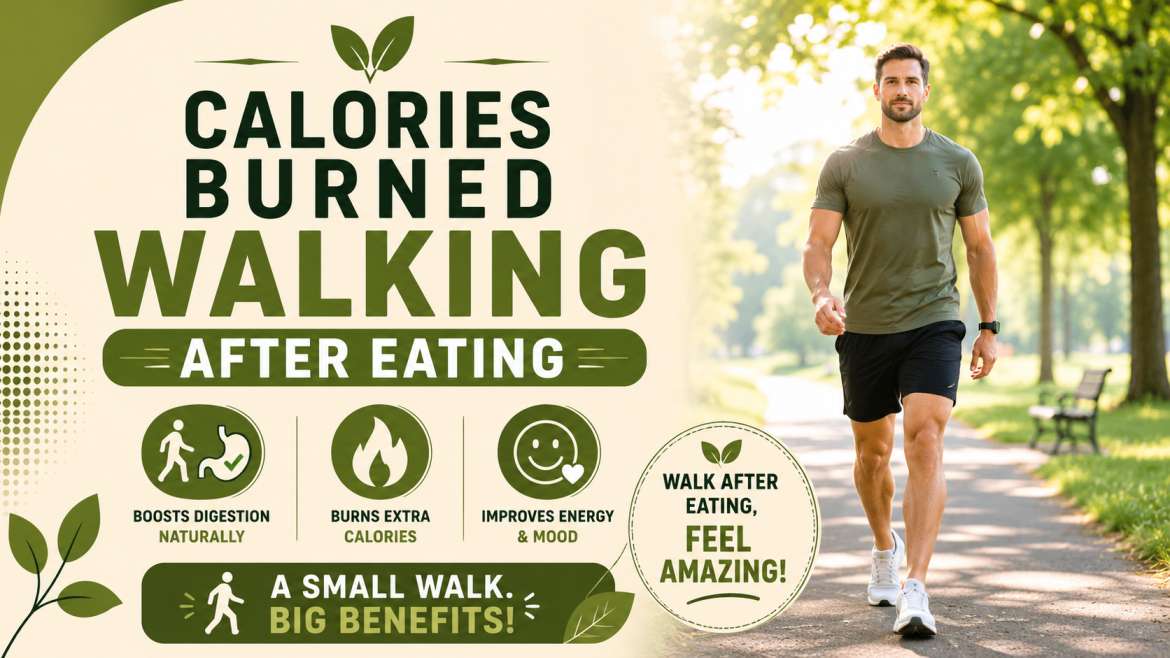
Walking after eating burns the same calories per step as walking at any other time of day, and delivers a set of metabolic benefits no other walk timing can match. A 154 lb (70 kg) person walking 15 minutes at brisk 3.5 mph after a meal burns approximately 75 calories, using MET 4.3 from the 2024 Adult Compendium of Physical Activities. The deeper benefit goes beyond the calorie count: post-meal walking reduces postprandial blood glucose spikes, supports digestion, lowers blood pressure, and creates a cumulative daily calorie deficit that compounds over weeks.
The walking calorie calculator estimates post-meal walk calorie output by weight, pace, and duration. The walking calories hub covers every walking format in the cluster. The calories burned guide places post-meal walking in the broader activity context. Use the TDEE calculator to understand how post-meal walks contribute to your daily energy balance.
Is Walking After Eating Good for You?
Walking after eating is good for most healthy adults. A growing body of research from controlled trials and meta-analyses confirms clear benefits across digestion, blood sugar, cardiovascular health, and weight management. As Cleveland Clinic's Dr. Phillpott states: "Studies have shown that walking immediately after a meal can shorten the amount of time that food sits in the stomach, and that can really improve symptoms of feeling excessively full, reflux, abdominal pain, and others."
The key condition is intensity. Light to moderate walking (2 to 4 mph) immediately or shortly after eating is safe and beneficial for most adults. Intense exercise directly after a large meal can cause nausea or cramping and should be avoided.
Who Benefits Most from Walking After Eating?
Post-meal walking benefits are relevant across the general population, but some groups see the strongest effects:
People with or at risk for Type 2 diabetes post-meal walking is more effective than any other time for reducing glucose spikes
Adults with insulin resistance even 10-minute post-meal walks reduce postprandial hyperinsulinemia
Anyone experiencing bloating or post-meal heaviness walking accelerates gastric emptying
Adults managing weight split post-meal sessions accumulate daily calorie output more sustainably than single long walks
People with acid reflux upright movement reduces stomach acid pressure
What Are the Benefits of Walking After Eating?
Research across clinical trials, meta-analyses, and cohort studies identifies six distinct categories of benefit from post-meal walking.
1. Blood Sugar Control
This is the most researched and strongest benefit. When you eat, blood glucose rises as carbohydrates are broken down, peaking 30 to 60 minutes after a meal. Walking activates muscle contractions that pull glucose from the bloodstream directly, independent of insulin. This reduces the peak and flattens the glucose curve.
A 2022 randomised study in Nutrients (Bellini et al.) found 30 minutes of brisk post-meal walking substantially reduced glucose peaks after meals with varying carbohydrate content. A 2023 meta-analysis confirmed walking within 30 minutes of eating is more effective than walking 30 minutes before eating for blood sugar regulation (Healthline, citing PMC systematic review 2023).
A small 2025 study found that walking for 10 minutes immediately after eating was as effective as taking a 30-minute walk 30 minutes after eating for glucose control. Shorter timing outperforms longer delay.
2. Improved Digestion
Walking stimulates peristalsis the muscular contractions that move food through the digestive tract. Research confirms walking after eating speeds up the time it takes food to move from the stomach into the small intestines. This can help reduce bloating, gas, and post-meal heaviness that follow eating, particularly after larger meals.
A 2008 study in the Journal of Gastrointestinal and Liver Disease (Franke et al.) found postprandial walking accelerates gastric emptying in healthy volunteers, more effectively than consuming alcoholic digestifs or espresso.
3. Weight Management Support
Post-meal walking supports weight loss through cumulative daily calorie output. A study by Hijikata (2011, Int J Gen Med) tracked two adults who fast-walked after lunch and dinner for one month. The faster walker lost approximately 3 kg; the slower walker lost 1.5 kg with no other lifestyle changes. Walking after eating also reduces the appetite rebound that follows meals in some individuals, lowering total daily calorie intake.
4. Cardiovascular Health
Regular walking is associated with reduced cardiovascular disease risk and lower blood pressure. A 2023 meta-analysis found the more frequently you walk, the lower the risk of death from cardiovascular disease. A 2009 meta-analysis showed walking approximately 30 minutes a day, five days a week, was associated with a 19% reduction in coronary heart disease risk (Peloton, citing published meta-analysis). Post-meal walks contribute directly to this weekly volume.
A 2020 study found cardiovascular and mortality risk in men decreased most when participants walked at a faster pace, supporting brisk post-meal walking over slow strolling for heart health.
5. Reduced Acid Reflux Risk
Lying down after eating increases the risk of acid reflux because stomach acid can rise into the oesophagus in a horizontal position. Walking maintains upright posture and gentle forward movement, reducing stomach pressure. BodySpec confirms: "upright posture and gentle movement reduce stomach pressure, easing reflux in many people." For people who experience post-meal reflux, a short slow walk is preferable to resting on the sofa or bed.
6. Mood and Energy
Research from a 2018 study (Edwards et al., Health Promotion Perspectives) found brief single bouts of walking significantly improved mood profile in young adults. Post-meal lethargy, commonly called the "food coma," is reduced by light physical activity. Even two to five minutes of movement immediately after eating can help counter post-meal energy dips by improving circulation and oxygenation.
How Many Calories Does Walking After Eating Burn?
Post-meal walk calorie burn uses the standard MET formula: Calories = MET × weight (kg) × duration (hours). Output is identical to walking at any other time at the same pace and duration.
Post-Meal Walk Calories by Duration and Weight (Brisk 3.5 mph)
Duration | 120 lb (54 kg) | 154 lb (70 kg) | 185 lb (84 kg) | 220 lb (100 kg) |
|---|---|---|---|---|
10 minutes | 38 kcal | 50 kcal | 60 kcal | 72 kcal |
15 minutes | 58 kcal | 75 kcal | 90 kcal | 108 kcal |
20 minutes | 77 kcal | 100 kcal | 120 kcal | 143 kcal |
30 minutes | 115 kcal | 150 kcal | 180 kcal | 215 kcal |
45 minutes | 173 kcal | 226 kcal | 270 kcal | 322 kcal |
MET 4.3 at 3.5 mph, flat terrain. Source: 2024 Adult Compendium of Physical Activities.
A 15-minute walk after eating calories at 154 lb: approximately 75 kcal. Walking after dinner for 30 minutes burns approximately 150 kcal for the same person. The calorie output is the same whether the walk happens after breakfast, lunch, or dinner.
Post-Meal Walk Calorie Burn at Different Paces
Pace changes post-meal walk calories per minute significantly. A brisk 30-minute post-dinner walk burns 70% more than a slow stroll over the same duration.
30-Minute Post-Meal Walk by Pace (154 lb / 70 kg)
Pace | Speed | MET | Calories |
|---|---|---|---|
Slow stroll | 2.0 mph | 2.5 | 88 kcal |
Casual walk | 2.5 mph | 3.0 | 105 kcal |
Moderate walk | 3.0 mph | 3.5 | 122 kcal |
Brisk walk | 3.5 mph | 4.3 | 150 kcal |
Fast walk | 4.0 mph | 5.0 | 175 kcal |
For brisk pace, brisk walking is also more effective than slow walking for blood glucose management because higher intensity increases muscle glucose uptake more rapidly. The recommended post-meal pace from Healthline is approximately 3 mph (5 km/h) fast enough to elevate heart rate without being out of breath.
How Long Should You Walk After Eating?
Research has not identified a single optimal duration for post-meal walking. Practical guidance from multiple sources converges on 10 to 30 minutes as the effective range.
Duration Guidelines by Goal
Goal | Recommended Duration | Pace |
|---|---|---|
Minimum glucose benefit | 10 minutes | Moderate (3 mph) |
Meaningful glucose control | 15 to 20 minutes | Brisk (3 to 3.5 mph) |
Weight management | 20 to 30 minutes | Brisk (3.5 mph) |
Maximum calorie output | 30 to 45 minutes | Brisk to fast |
Digestion + acid reflux | 10 to 15 minutes | Gentle (2.5 to 3 mph) |
A 2025 study found 10 minutes immediately after eating matched a 30-minute walk 30 minutes after eating for glucose effects. DiPietro et al. (2013) used 15-minute moderate walks in three post-meal sessions. Healthline recommends 10 to 30 minutes for most adults.
The practical takeaway: 10 minutes is enough if timing is immediate. Longer walks at brisk pace add more calorie output and greater cardiovascular benefit.
How Soon After Eating Should You Walk?
The optimal timing for post-meal walking is as soon as possible after eating, according to the most consistent research signal. Blood glucose begins rising within 15 minutes of finishing a meal, peaks at 30 to 60 minutes, and starting a walk before the peak produces the greatest glucose reduction.
Timing Guidance by Meal Size
Meal Size | Recommended Wait | Reason |
|---|---|---|
Snack (under 300 kcal) | 0 to 5 minutes | Light load, walk immediately |
Regular meal (300 to 600 kcal) | 5 to 15 minutes | Allow initial digestion to begin |
Large meal (over 600 kcal) | 15 to 30 minutes | Reduce cramping risk |
Very large meal (900+ kcal) | 30 minutes | Minimise digestive discomfort |
Based on Freebeat, Healthline, and NetMeds clinical guidance synthesis.
Hijikata (2011, PMC) found: "walking at a brisk speed for 30 minutes as soon as possible after lunch and dinner leads to more weight loss than walking beginning one hour after a meal." The study confirms walking immediately after eating is more effective for both glucose and weight loss than waiting.
For most people eating regular meals, starting a walk within 5 to 15 minutes of finishing is the sweet spot. Waiting 10 minutes for the first stage of digestion to begin prevents discomfort without losing the glucose management window.
Are There Any Side Effects of Walking After Eating?
Walking after eating has very few side effects for most adults at light to moderate intensity. Healthline confirms: "while walking after eating has very few associated negative side effects, in some cases it may cause gastrointestinal symptoms."
Possible Side Effects and Who Experiences Them
Side Effect | Who Is Most at Risk | Solution |
|---|---|---|
Abdominal cramping | People with IBS or after very large meals | Wait 15 to 20 min; walk at slower pace |
Nausea or bloating | Individuals with sensitive digestion | Start with 5-minute slow strolls; build up |
Side stitch | Walking too fast too soon after eating | Slow down; breathe deeply |
Heartburn | Those with GERD who walk at high intensity | Stick to slow, gentle pace |
These side effects are almost entirely associated with high-intensity walking or running immediately after large meals. Light to moderate walking (2.5 to 3.5 mph) is safe and well-tolerated for the vast majority of healthy adults regardless of meal timing. Continental Hospitals confirms: "light activities such as walking or gentle stretching can aid digestion and are typically safe to perform after a meal."
Does Walking After Eating Burn More Calories Than Walking Before?
Walking after eating does not burn more gross calories than walking before eating at the same pace and duration. The MET formula is constant regardless of timing.
The Thermic Effect Overlap
The body burns calories digesting food (the thermic effect of food, approximately 10% of meal calories). During a post-meal walk, exercise and digestion happen simultaneously. This does not stack to produce extra calories, but it means the body is in a higher metabolic state during the first 30 to 60 minutes post-meal.
The Fat Oxidation Comparison
Fasted walking before breakfast draws more heavily on fat as a fuel source because liver glycogen is partially depleted overnight. Post-meal walking draws primarily on carbohydrates from the recent meal. Total fat burned over 24 hours is determined by the overall calorie deficit, not the fuel mix during any single walk.
The research conclusion: post-meal and pre-meal walking produce equal gross calories per step. The metabolic outcome differences blood glucose, digestion, acid reflux are not reflected in calorie counts on trackers.
Walking After Eating for Weight Loss
Post-meal walking supports weight loss through three distinct mechanisms beyond raw calorie burn.
Three reasons it works:
Cumulative split-session volume: Three 15-minute post-meal walks produce 45 minutes of daily walking in manageable segments, which most people sustain more consistently than one 45-minute block
Appetite management: Research suggests moderate post-meal exercise reduces the appetite rebound that follows eating, lowering total daily calorie intake in some individuals
Glucose and insulin control: Reducing postprandial glucose spikes lowers repeated hyperinsulinemia, which research links to reduced fat-storage signalling over time
Weekly Calorie Output from Post-Meal Walking (154 lb, Brisk Pace)
Strategy | Daily Output | Weekly Total |
|---|---|---|
1 × 15-min walk after dinner | 75 kcal | 525 kcal |
1 × 30-min walk after dinner | 150 kcal | 1,050 kcal |
3 × 15-min walks after each meal | 225 kcal | 1,575 kcal |
2 × 30-min walks after lunch + dinner | 300 kcal | 2,100 kcal |
Three 15-minute post-meal walks daily burns more total calories than one 30-minute walk. This matches the DiPietro finding that split post-meal bouts outperform single longer sessions for glycemic control.
15-Minute Walk After Eating Calories by Body Weight
A 15-minute walk after eating is the research-validated minimum effective duration. The DiPietro (2013) study used 15-minute moderate walks. The 2023 systematic review confirmed 20 minutes immediately after eating has an acute beneficial impact.
Body Weight | 15 Min at 3.0 mph | 15 Min at 3.5 mph | 15 Min at 4.0 mph |
|---|---|---|---|
120 lb (54 kg) | 47 kcal | 58 kcal | 66 kcal |
130 lb (59 kg) | 52 kcal | 63 kcal | 74 kcal |
154 lb (70 kg) | 61 kcal | 75 kcal | 88 kcal |
185 lb (84 kg) | 74 kcal | 90 kcal | 105 kcal |
220 lb (100 kg) | 88 kcal | 108 kcal | 125 kcal |
Gross calories, flat terrain.
For longer post-meal walking sessions, the calories burned walking 30 minutes and calories burned walking 45 minutes pages provide full weight and pace tables.
Walking After Eating vs Other Walking Formats
Post-meal walking produces the same calorie output as any equivalent walk. Split post-meal sessions versus single daily blocks:
Format | Daily Walking Time | Weekly Calories (154 lb, Brisk) |
|---|---|---|
1 × 30-min morning walk | 30 min | 1,050 kcal |
1 × 45-min afternoon walk | 45 min | 1,582 kcal |
3 × 15-min post-meal walks | 45 min | 1,582 kcal |
1 × 30-min + 3 × 15-min | 75 min | 2,625 kcal |
Three 15-minute post-meal walks produce identical calories to one 45-minute afternoon walk at the same pace. The glucose management benefit comes at no additional calorie cost versus equivalent walking at other times.
For short walking sessions that fit a lunch break, the calories burned walking 20 minutes page covers that duration with full weight tables. For the per-mile rate during a post-meal walk, the calories burned walking per mile page covers weight-adjusted estimates.
Frequently Asked Questions About Walking After Eating
Is Walking After Eating Good for You?
Walking after eating is good for most healthy adults at light to moderate intensity. Research confirms benefits across blood sugar control, digestion, cardiovascular health, weight management, and mood. The strongest evidence is for blood glucose regulation: walking within 30 minutes of a meal is more effective than any other timing for reducing postprandial glucose spikes.
How Long Should You Wait Before Walking After Eating?
For regular meals, waiting 5 to 15 minutes before walking is generally sufficient. After a large meal, waiting 15 to 30 minutes reduces the risk of cramping or nausea. A 2011 PMC study confirms walking immediately after a meal is more effective for weight loss and glucose control than waiting one hour, for people who experience no discomfort walking right away.
How Many Calories Does Walking After Eating Burn?
Walking after eating burns 50 to 215 calories per 30 minutes depending on body weight and pace. A 154 lb (70 kg) person burns approximately 75 kcal in a 15-minute brisk post-meal walk and approximately 150 kcal in a 30-minute walk. The calorie count is identical to equivalent walking at any other time of day.
Does Walking After Eating Help with Bloating?
Walking after eating reduces bloating by stimulating peristalsis and accelerating gastric emptying. A 2008 study (Franke et al., JGLD) found post-meal walking sped up gastric emptying in healthy volunteers. Cleveland Clinic recommends walking immediately after heavier meals specifically to reduce feelings of fullness and heaviness.
Is Walking After Eating Good for Weight Loss?
Walking after eating supports weight loss through cumulative calorie burn, appetite control, and improved glucose management over time. Three 15-minute post-meal walks daily create approximately 1,575 kcal of weekly exercise output for a 154 lb person, more than a single 30-minute daily walk, while also reducing the insulin-driven fat-storage signals associated with large glucose spikes.
What Is the Best Time to Walk After Eating?
Walking as soon as possible after eating within 5 to 15 minutes captures the greatest glucose reduction benefit. For weight loss, total weekly walking volume matters more than precise timing. Three 15-minute post-meal walks daily produce the same weekly calorie output as one 45-minute daily walk while also capturing the metabolic benefits unique to post-meal timing.